How to jam
Three days, one puzzle game, and a plan with more crossed-out lines than legible ones. Not a tutorial, sorry.
Disclaimer: this is not a tutorial. I have no idea how to jam. I just did one, and the only thing I can teach you is what happened, which is a different thing and a lot less useful.
The jam was Mini Jam 221, three days long, theme Staying Warm. The result is The Sacred Algorithm, a puzzle game about a family of chips whose job is to keep social network conversations warm. By starting fights.
Exploring without a map
The first thing the theme suggested was a little character (or several) trying not to freeze somewhere hostile. I saw it so clearly that alarm bells went off: too obvious.
The second thing was to turn the theme over some more and look for other readings. There was a lot more in it than it seemed. But I had no time to explore open water, so I picked one and started rowing.
I settled on a reading: social networks need to keep the conversation warm to keep their users hooked, ideally until their next vital need forces them back into the real world.
And the most tried-and-tested mechanism for that is conflict. Another avalanche of ideas. The clock never stopped. I tried my luck with a game about placing pieces on a hexagonal board, where each piece was an opinion and contact with opposing ones generated heat.
The goal was to optimize interactions. On paper, the numbers added up. In practice it was a spreadsheet with hexagons: neither interesting nor fun. I had to change course, and the port was a long way back.
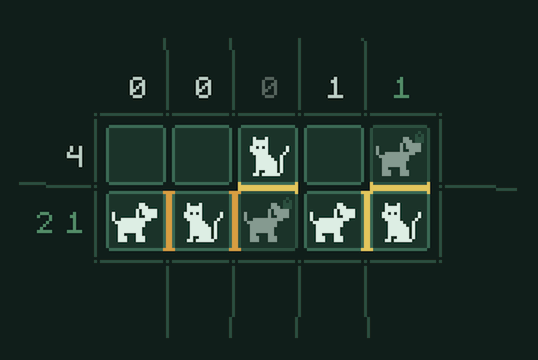
Then, with almost the same pieces and a nudge from my Picross addiction, I asked myself: what if the board were a nonogram?
It would no longer be about finding the maximum heat: you would have to deduce it from the numbers in the margins.
From there the wind blew in my favor: a nonogram is solved by deduction, and deduction is fun.
I placed no more bets.
Three days is a tight budget
A short deadline doesn’t ask you to be ambitious. It asks you to pick.
When you’re swimming in an ocean of ideas, it’s easy to get lost, and that’s fine: getting lost is how you end up in new places. What you can’t do is take everything with you. If I had to give a piece of advice, and I’m not saying I’m giving it, it would be: explore all you want, but don’t let your to-do list grow longer than the time you have to do it.
Some of the decisions I made:
- One rule. Two neighbors either agree or clash. I didn’t have time for a second rule, so I had to find out how much one could give. It gave more than I expected.
- No fail state. No timer penalty, no move limit, no lives. It was one less system to build. It also turned out to be a design statement: you can’t lose, so you can try anything.
- Only easy puzzles. I didn’t have time to design hard ones, and nobody has time to play them in a jam anyway. It turned out to fit the theme: the game is a warm-up. The harder levels can wait for the next pack.
The deadline doesn’t discard ideas. You do.
Art on a diet
The first prototype had a crew of emojis. It was enough to show the idea worked. But they were generic, the same ones everybody already has on their phone, and I wanted something with soul. The emojis had to go overboard.
I am the tech guy. Pixel art takes me a while, and three days is not a while.
Retro games come with serious restrictions: low resolution, few colors, a handful of frames. It’s the perfect excuse to save work. Besides, I love them. The Analogue Pocket next to my keyboard is proof.
I did want it sober. A dark background, a grid, some numbers, and nothing that gets between you and the deduction. What I didn’t expect is that, once there was nothing left to remove, it would look elegant.
This kind of game doesn’t need an AAA budget. But I was surprised by how quickly the art came together. Thanks, Aseprite, I guess!
So I moved on to indulging in useless details: lines that move for no apparent reason, like restless cables. Without losing the minimalism, or so I thought. I’m not ashamed to admit I deleted a few monstrosities that didn’t deserve to see daylight.
Puzzle games can be cold. Conflict with the jam theme detected! And since I’d cut so much, I still had time left. I decided to spend it on characters and a little narrative rather than on harder puzzles.
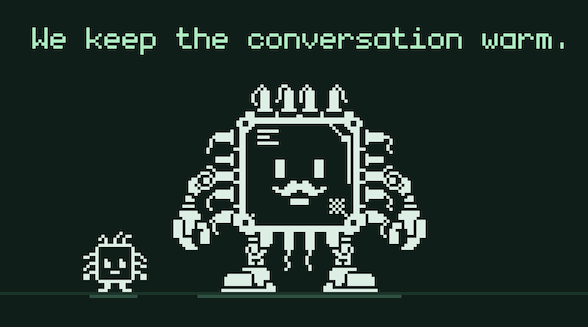
The algorithm needed a face, and the closest one was a chip’s. Chippy and Fatherchip are a cute father-and-son pair, with a single sprite each. The animation is code. A hop, a lean, a sad little squash. And the dialogue provides the rest.
That dialogue has a second job. The rules were new, they aren’t quite those of a real nonogram, and nobody reads an instruction sheet. So the tutorial is a conversation: a solemn father explaining the world to his son and, while he’s at it, how to solve the board.
Landfall
I hadn’t done a jam in years. I’d forgotten how hard and intense it is. How much fun it can be, if you let the tide carry you. And how rewarding it is to see your game finished: a prototype or whatever, but finished and playable.
Because deep down, that’s what we’re here for: to play.
If this really were a tutorial, which it isn’t, it would say: write down your plan, then be ready to throw it away. Cut things until it hurts, then cut more. Design and draw less. Let the clock design the parts you can’t.